By Prof. Dr Lieven Annemans, expert trainer of the courses
Health Economics for Non-Health-Economists, Basics of Health Economics, and Critical New HTA Developments in Europe: Challenges & Solutions
The difference between health economic evaluations and Health Technology Assessments (HTAs) is not always clear to everyone. Improper use of these terms can cause confusion and misunderstanding.
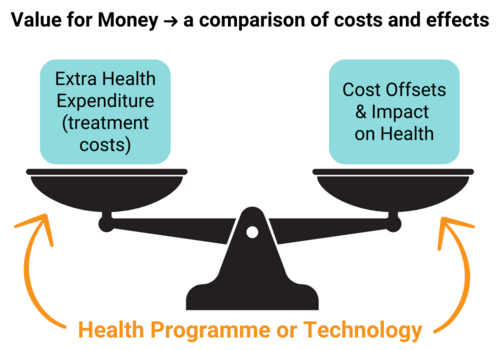
A health economic evaluation compares alternative courses of action in terms of their costs and health consequences. A Health Technology Assessment is broader: it weighs those alongside the medical, social, organisational and ethical implications. Any HTA should include a health economic evaluation, but an HTA is more than one.
What is a health economic evaluation?
➡ The comparative analysis of alternative courses of action (for instance a new medicine versus the standard of care) in terms of both their costs and health consequences.
What is a Health Technology Assessment?
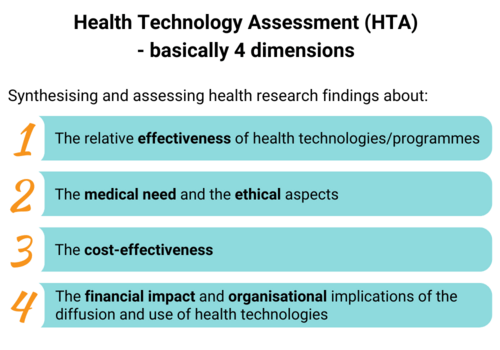
➡ HTA seeks to inform health policymakers by using the best scientific evidence on the medical, social, economic, and ethical implications of investments in healthcare.
Source: https://www.inahta.org
The two, side by side
| Health economic evaluation | Health Technology Assessment | |
|---|---|---|
| What it weighs | Costs and health consequences | Medical, social, economic, organisational and ethical implications |
| What it compares | Alternative courses of action, for instance a new medicine versus the standard of care | The new technology against existing treatments, across six components |
| What it is for | Showing whether the health benefits justify the net cost | Informing health policymakers with the best scientific evidence |
What a full HTA comprises
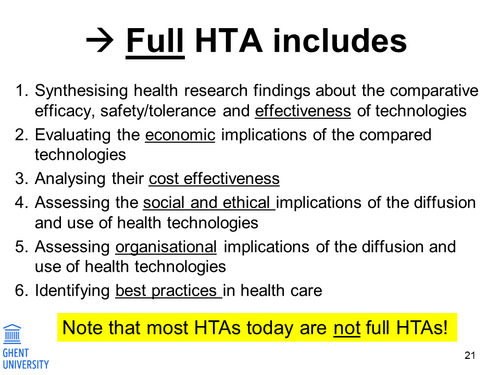
A full HTA has six components, each needing its own analysis. Many HTAs carried out today are not full HTAs.
Synthesising health research findings about the comparative efficacy, safety/tolerance, and effectiveness of technologies.
This involves a comprehensive review of published studies and clinical trials to determine how the new technology compares to existing treatments. The key question is: how much better is it for patients (more quality of life and/or life expectancy) and for the healthcare system (e.g. avoided hospitalisations).
The economic implications.
What are the direct (healthcare use and costs) and indirect (productivity related) costs associated with the new treatments compared to the costs of existing treatments. To which extent can the extra cost of the new treatment be offset by savings elsewhere? Hence, what is the net cost of the new technology?
The cost-effectiveness analysis of the new technology.
Putting 1. and 2. together, this component involves determining whether the new technology provides enough health benefits to justify the net cost compared to existing treatments.
The social and ethical implications of the diffusion and use of health technologies.
Considerations are made on how the new technology will affect patients, their families, and society as a whole.
The organisational implications of the diffusion and use of health technologies.
This step involves considering the impact of the new technology on healthcare providers and organisations, including its integration into existing systems and workflows.
Identifying best practices in healthcare and assessing how the new technology can be optimally used to improve the overall quality of care for patients and health systems performance.
So, it’s not the technology as such that is assessed, but the way it is applied.
Where the joint clinical assessment stops
The joint clinical assessment (JCA) focuses on the clinical domains only. The health economic evaluation is not part of it, and stays with each country.
What an HTA assesses, domain by domain:→ The clinical and non-clinical domains of Health Technology Assessment |
The terms in this article, and fifteen more, defined in one place:→ Health economics glossary: key terms you need to know |
Prof. Dr Lieven Annemans on why healthcare decisions in Europe turn on value for money, in a short video:📺 Why healthcare decision-making in Europe is about value for money |
Continue your learning from Prof. Dr Lieven Annemans
If you’d like to learn more from Prof. Dr Lieven Annemans, CELforPharma also offers 3 courses:
2-day course in Brussels:
Health Economics for Non-Health-Economists
With Prof. Dr Lieven Annemans

1-day live online course:
Basics of Health Economics
With Prof. Dr Lieven Annemans
1-day live online course:
Critical New HTA Developments in Europe: Challenges & Solutions
With Prof. Dr Lieven Annemans
Don’t miss the latest insights from our expert faculty
Subscribe to our newsletter to:
- Stay on top of the latest expert insights
- Receive invitations to upcoming educational webinars
- Get updates on our courses and training programmes