For BD&L professionals in pharma & biotech
By Dr Carlos Velez, expert trainer of The AI for Pharma Business Development & Licensing Course and Business Development & Licensing Course For Pharma & Biotech.
A working check for business development & licensing professionals in life sciences.
AI can produce a partner brief, an rNPV model or a due-diligence memo in minutes. Whether that file is safe to send to a licensor, licensee or your management team is a separate question.
It comes down to five checks: source traceability, labelled assumptions, live calculations, verified numbers and independence from the person who built it. If a file fails any one of these, it is not finished yet, no matter how polished it looks.
Business development & licensing teams in pharma and biotech use large language models to draft partner briefs, build rNPV and revenue models, and summarise due-diligence findings, whether they're scouting an in-licensing candidate or preparing an out-licensing data room. The output looks professional: clean formatting, confident language, numbers that line up neatly across tabs and slides.
But looking finished and being correct are different things, and the gap between them is where AI-generated errors travel quietly into deal decisions. A hardcoded cell, an unsourced regulatory claim or a slightly wrong prevalence figure reads exactly the same as a verified one, right up until a licensor, a licensee or your own management team relies on it.
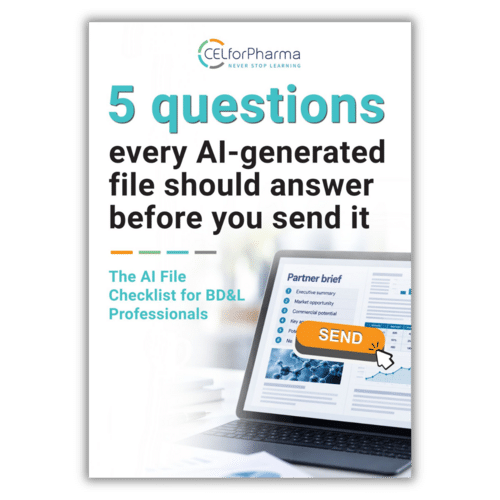
Want to take these tips with you?
Download the AI file checklist below 👇
The check itself is not complicated. Before an AI-generated brief, model or memo leaves your outbox, it should be able to answer five questions.
The checklist
Can you trace every claim back to a source?
Every factual statement in the file should carry a visible source: a document name, a date, a reference. If you cannot say where a claim came from, treat it as unverified, not true.
Language models are fluent, not evidential. They will state a trial result or a patent expiry date with exactly the same confidence whether it came from an approved source or from a plausible pattern in their training data.
Are assumptions clearly separated from facts?
Assumptions, estimates and placeholders should be visibly labelled as such, not folded into the same sentence as sourced data.
"Peak sales of $800 million" reads identically whether it is a sourced forecast or an AI-generated placeholder, unless the file tells you which.
Do the calculations update automatically?
In any AI-built financial model, check whether changing an input actually changes the output. Hardcoded values dressed up as formulas are one of the most common, and hardest to spot, AI errors in spreadsheets.
A discount rate cell can look live but was pasted in as a static value. Change the assumption and the valuation does not move, and nothing in the formatting tells you so.
Has every number been checked against its original source?
Cross-check figures against the underlying document, not the AI's summary of it. Small transcription errors are easy for a model to introduce and easy for a reader to miss.
A prevalence estimate of 250,000 instead of 200,000 will not look wrong on the page. It will only look wrong next to the source.
Would the file hold up without you in the room to explain it?
If a colleague forwarded the file with no commentary from you, would every number and claim still make sense on its own? If the answer is no, the file is not ready to leave your hands.
The discipline behind the questions
None of this is about distrusting AI tools. It is about applying the same verification discipline you would apply to a junior analyst's first draft: check the sources, separate fact from assumption, and confirm the numbers actually work before your name goes on the file. The tools are new. The standard is not.
Download the AI file checklist:
FAQ
AI tools are genuinely useful for drafting, structuring and first-pass analysis in life sciences business development and licensing work, but outputs still need human verification before they inform a deal decision. The risk is not that the tools are unreliable in general, it is that confident, well-formatted output can hide unsourced claims, unlabelled assumptions or hardcoded figures in a partner brief or valuation model. A short check before sending closes most of that gap.
A hardcoded value dressed up as a formula. The cell looks like it recalculates, but changing an input assumption, such as probability of success or peak sales, does not change the output. Test it directly: change one assumption and confirm the downstream numbers actually move.
Yes, less often than in earlier model generations, but they have not disappeared, particularly for specific figures, citations and dates such as trial results, patent expiry or deal comparables. Every AI-assisted output used in a licensing decision should still be treated as something to verify, not something to take on trust.
Continue your learning from Carlos
If you’d like to learn more from Carlos, CELforPharma also offers a 1-day, hands-on course where you'll learn how to:
- Use AI to support opportunity scouting and partner identification
- Apply AI during asset evaluation and due diligence preparation
- Structure information and analysis to support decision-making
- Explore how AI can assist negotiation preparation and deal planning
- Recognise where professional judgement remains essential when using AI in BD&L
The AI for Pharma Business Development & Licensing Course
With Dr Carlos Velez

Don’t miss the latest insights from our expert faculty
Subscribe to our newsletter to:
- Stay on top of the latest expert insights
- Receive invitations to upcoming educational webinars
- Get updates on our courses and training programmes