By Dr Nick Proctor and Louisa Oliver Byrne, expert trainers of the Understanding Pharma Market Access in the US course.
In the United States, access to healthcare is structured into two benefit types: medical and pharmacy.
Medical benefit covers drugs a healthcare provider administers, and is managed by the Managed Care Organisation. Pharmacy benefit covers drugs a patient takes themselves, and is managed by a Pharmacy Benefit Manager. Which of the two a product falls under decides how it is covered, what the patient pays, and how the claim is processed.
Key distinctions between medical and pharmacy benefits
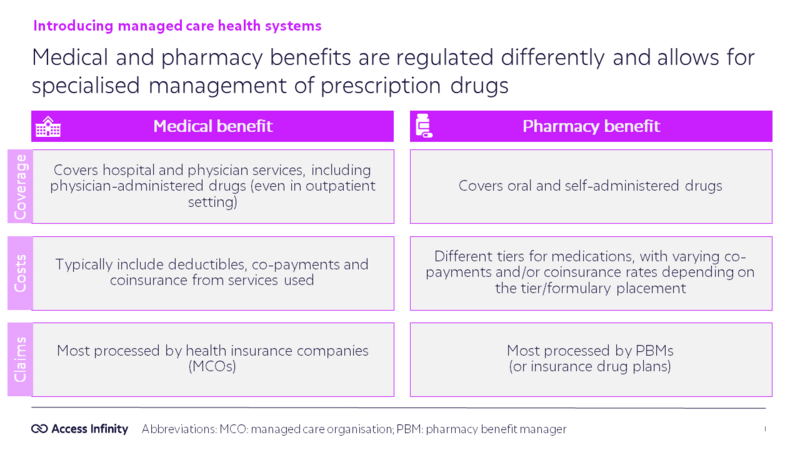
Coverage
Medical benefit: hospital stays, outpatient services, and drugs administered by a healthcare provider, including in an outpatient setting, such as chemotherapy infusions or some vaccines.
Pharmacy benefit: retail prescription drugs, including maintenance medications for chronic conditions like diabetes or hypertension.
Costs
Medical benefit: deductibles, co-payments and coinsurance tied to the medical services the patient uses.
Pharmacy benefit: a tiered formulary system, where what a patient pays out of pocket depends on the tier the drug sits in.
Claims
Medical benefit: most claims are processed through health insurance companies, the Managed Care Organisations (MCOs).
Pharmacy benefit: claims are typically processed through Pharmacy Benefit Managers (PBMs), or private drug plans.
Who manages it
Medical benefit: medical directors within the MCO, influenced by general healthcare regulations, making sure services align with clinical care standards at an appropriate cost.
Pharmacy benefit: PBMs and pharmacy directors, who negotiate drug prices and manage formularies to balance cost and benefit.
Managed care considerations
Managed care systems are central to balancing the medical and pharmacy benefits for patients and providing a comprehensive health plan to its members. These systems coordinate funding from various sources - government programmes like Medicare and Medicaid, employers, and patients.
MCO, PBM, formulary and the rest of the vocabulary, defined in one place:→ Your US market access glossary |
Continue your learning from Nick and Louisa
If you’d like to learn more from Nick and Louisa, CELforPharma also offers a 1-day, hands-on course where you'll:
- Understand the structure and key players of the US managed care system
- Distinguish between medical and pharmacy benefits and how pricing and access controls differ between them
- Clarify the role and influence of Pharmacy Benefit Managers (PBMs)
- Explore the implications of recent US policy developments like MFN
- Recognise common challenges and approaches to US market access
Understanding Pharma Market Access in the US
With Dr Nick Proctor & Louisa Oliver Byrne


Don’t miss the latest insights from our expert faculty
Subscribe to our newsletter to:
- Stay on top of the latest expert insights
- Receive invitations to upcoming educational webinars
- Get updates on our courses and training programmes