Why communicating uncertainty is one of the most underrated skills in pharma planning
Expert insight by Dr Neal Hansen and Mitchell Cooke, faculty members of Managing Uncertainty & Risk in Pharma Marketing & Medical Planning
Most pharma professionals are trained, explicitly or implicitly, to project confidence. Confidence in the forecast. Confidence in the strategy. Confidence in the plan. Leadership expects it. Reviews reward it. And over time, teams learn to present certainty even when certainty does not exist, and to neglect communicating where it does.
The problem is that markets do not always evolve as we expect them to. Guidelines shift. Competitors move faster than anticipated. Access decisions go against the base case. And when reality diverges from the plan that was presented as certain, the credibility damage can be significant.
There is a better approach — and it requires learning a skill that feels counterintuitive: the ability to communicate clearly and confidently about what you do not yet know.
What This Insight Covers
The confidence trap — why pharma teams learn to hide uncertainty, and why this backfires
The #1 rule — why uncertainty must always be paired with a management plan
Up vs. down communication — what leadership and teams each need to hear
Six practical techniques — concrete habits that build credibility in planning cycles
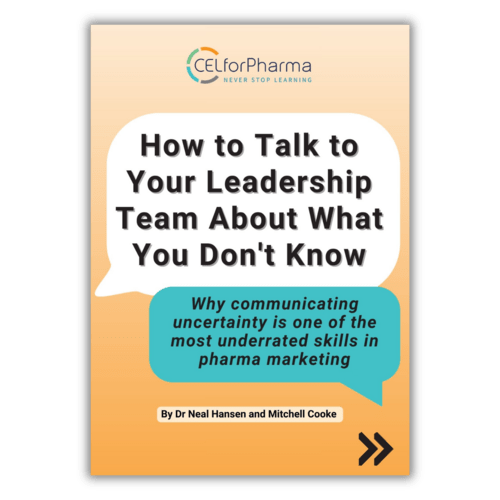
Want to take this guide with you?
Download the complete ebook below 👇
The Confidence Trap
True credibility comes not from projecting certainty, but from demonstrating that you understand your market deeply — including the parts that are still unclear. A leader who presents a plan that acknowledges key uncertainties, explains how they were identified, and describes how the team is monitoring and managing them, is far more credible than one who presents a plan as though nothing could go wrong.
The confidence trap works like this: teams feel pressure to present clean, strong narratives to leadership. Uncertainties are noted briefly in an appendix, if at all. The base case becomes the only case. And when something changes — as it always does — the team is left explaining not just what happened, but why they did not see it coming.
"The goal is not to eliminate uncertainty from your communication. The goal is to show that you are managing it."
The One Rule That Changes Everything
Before specific techniques, there is one principle that underpins all effective communication of uncertainty:
❌ Without the plan
"Revised guidelines will be released just before launch and we are unsure how favourable they will be to our product"
This hands an open problem to your audience.
✅ With the plan
"We are not sure, therefore we have built scenarios for what they could be with distinctly different implications, and defined what we will do should any of them become a reality."
This demonstrates structured capability.
Communicating Up and Down the Organisation
Effective uncertainty communication looks different depending on the direction, and both are frequently neglected.
- Communicating upward means giving leaders the full picture they need to allocate resources appropriately, adjust timelines, or provide backing for contingency plans. When teams filter out uncertainty before presenting upward, they prevent leadership from making better-informed decisions faster.
- Communicating downward means helping teams understand which parts of the plan are stable and which are genuinely uncertain. Teams that have this context adapt better, stay more engaged, and contribute more effectively to early signal detection. Keeping uncertainty hidden from teams does not protect them — it leaves them less prepared when things change.
Six Practices That Work in Practice
The following approaches reflect how effective pharma marketing & medical leaders handle uncertainty communication in real planning cycles and leadership reviews.
- Say explicitly what you do not know. Distinguish between known unknowns — things you are aware of but cannot yet resolve — and unknown unknowns, where the landscape itself may shift in unpredictable ways. Naming this explicitly builds more trust than glossing over it.
- Pair every uncertainty with a plan. For every significant uncertainty you name, describe what you are monitoring, what scenarios you have prepared, or what decision criteria you will use. This transforms uncertainty from a concern into a managed process.
- Tailor the message to the audience. A C-suite audience needs strategic implications and decision points. A team leader needs operational clarity. The field team needs to know what is stable and what may change. The same uncertainty requires a different frame for each group.
- Replace the big reveal with regular check-ins. Annual planning cycles create pressure to present a finished, certain plan. Where possible, replace this with shorter, more frequent updates that track how key uncertainties are evolving. This keeps leadership informed and reduces the shock of unexpected changes.
- Be explicit about what is in and out of your control. Framing uncertainty as something the team is actively managing — rather than something happening to them — shifts the dynamic. Explain the factors you can influence and those you can only monitor.
- Create space for dialogue. The people you are presenting to often have information or signals that you do not. Framing uncertainty openly invites that input. A plan that invites challenge is stronger than one that discourages it.
"The pharma managers who build the most credibility are not those who are always right. They are those who show they are always thinking."
Take This Guide with You: Download the eBook
The frameworks for identifying and prioritising the uncertainty in the first place, free to download:→ The Risk & Uncertainty Toolkit for Pharma Marketing & Medical Planning |
Ready to Go Deeper?
This guide is only the beginning…
Continue your learning from Neal and Mitchell
If you’d like to learn more from Neal and Mitchell, CELforPharma also offers a 1-day, hands-on course where you'll:
- Learn a structured approach to identifying and categorising uncertainty and risk
- Gain a practical framework to prioritise and follow up on risk items
- Understand how to handle uncertainty based on risk profile and business impact
- Improve how you communicate uncertainty to internal stakeholders
Managing Uncertainty & Risk in Pharma Marketing & Medical Planning
With Dr Neal Hansen & Mitchell Cooke


Don’t miss the latest insights from our expert faculty
Subscribe to our newsletter to:
- Stay on top of the latest expert insights
- Receive invitations to upcoming educational webinars
- Get updates on our courses and training programmes