By Prof. Dr Thomas Wilke, expert trainer of the Generating RWE for Optimising Market/Patient Access course.
Why one type of study is not enough
Real-world evidence (RWE) has become a critical component of market access, pricing, and clinical decision-making. Yet there is still a common misconception about how RWE is actually generated and used.
Many assume that a single, well-designed RWE study can answer all relevant questions. In reality, that is rarely the case.
Individual RWE studies are often built to answer one specific research question, focusing on a clearly defined primary outcome. However, decision-makers rarely rely on a single outcome when evaluating a therapy.
What matters is not just the study, but the overall evidence strategy.
One study, one question
Like clinical trials, RWE studies are designed around a primary objective.
This means:
- A cost study focuses on healthcare resource use and cost
- An effectiveness study focuses on clinical outcomes
- An adherence study focuses on persistence and compliance
Trying to answer too many questions within a single study often leads to:
- methodological weaknesses
- unclear results
- reduced credibility with regulators and HTA bodies
Well-designed RWE studies are focused, precise, and transparent in what they aim to demonstrate.
But decision-makers don’t think in single outcomes
While individual studies are narrow by design, stakeholders are not.
Different decision-makers require different types of evidence:
- Regulators focus on benefit-risk
- HTA bodies assess comparative effectiveness and cost-effectiveness
- Payers look for real-world value and budget impact
No single outcome, and no single study, can satisfy all of these perspectives.
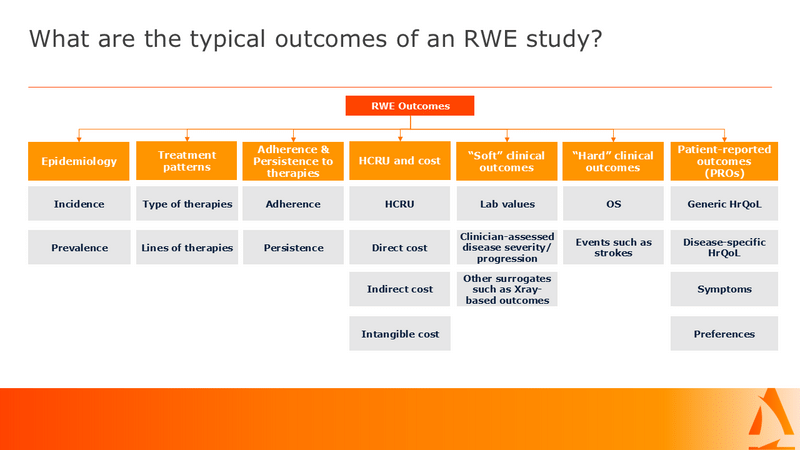
The range of RWE outcomes
Across RWE studies, a broad range of outcomes can be generated, including:
- Epidemiology (incidence, prevalence)
- Treatment patterns
- Adherence and persistence
- Healthcare resource use and costs
- Soft clinical outcomes (e.g. biomarkers, surrogate endpoints)
- Hard clinical outcomes (e.g. survival, major events)
- Patient-reported outcomes (quality of life, symptoms)
Each of these answers a different type of question.
From single studies to evidence strategy
The real value of RWE emerges when these different outcomes are generated across a coordinated set of studies.
For example:
- A treatment pattern study shows how patients are currently managed
- A comparative effectiveness study demonstrates clinical benefit
- A cost study quantifies economic impact
- A patient-reported outcome study captures patient relevance
Individually, each study provides a partial answer. Together, they create a coherent and persuasive evidence base.
Why this matters for market and patient access
Market access decisions are multi-dimensional.
To achieve reimbursement and adoption, companies must demonstrate:
- clinical value
- economic value
- relevance to real-world populations
- impact on patients’ lives
RWE plays a role across the entire product lifecycle, from early development to post-launch optimisation. This makes it essential to move beyond a “study-by-study” mindset.
Common mistake: letting data drive the question
A frequent pitfall in RWE is starting with available data rather than a clear strategic objective.
This often results in:
- studies that are easy to execute but hard to use
- evidence that does not align with stakeholder needs
- missed opportunities to support key decisions
Instead, the process should be reversed:
- Define the decision to support
- Identify the evidence required
- Design the appropriate RWE studies
The takeaway
RWE is not about running a single study; it is about building a structured evidence strategy where:
- each study has a clear purpose
- each outcome answers a specific question
- all studies together support a broader value story
Companies that approach RWE this way are far better positioned to:
- meet regulatory and HTA expectations
- support pricing and reimbursement
- demonstrate real-world value
Which evidence each stage of the lifecycle calls for, in one infographic:→ The role of RWE across the product lifecycle |
Continue your learning from Thomas
If you’d like to learn more from Thomas, CELforPharma also offers a 1-day, hands-on course where you'll:
- Understand the full spectrum of RWE study types and data sources
- Learn how RWE can support payer, HTA, and access decision-making
- Gain insight into study design and statistical considerations
- Exchange experiences through expert-led discussions and practical examples
Generating RWE for Optimising Market/Patient Access
With Prof. Dr Thomas Wilke

Don’t miss the latest insights from our expert faculty
Subscribe to our newsletter to:
- Stay on top of the latest expert insights
- Receive invitations to upcoming educational webinars
- Get updates on our courses and training programmes