Out-licensing a pharmaceutical product in R&D is a high-stakes process. Before you approach potential partners, or respond to their interest, you need to be certain that your product can withstand rigorous due diligence.
This checklist was developed by David Scott, an expert in pharmaceutical business development and licensing with decades of industry experience. It is used in his practical training course, The Pharmaceutical Out-Licensing Course, offered by CELforPharma.
Use this checklist to assess the readiness of your R&D product before entering any out-licensing discussion. It covers the five critical areas that potential licensees will examine: science and clinical data, regulatory and safety, manufacturing and supply, commercial and market, and legal and intellectual property.
Who is this checklist for?
This checklist is designed for pharmaceutical business development and licensing professionals who are preparing a product in R&D for out-licensing. It covers all the areas you will need to address before you can present your product with confidence to a potential partner. For many of the questions, you will need input from colleagues in R&D, regulatory affairs, medical affairs, and market access.
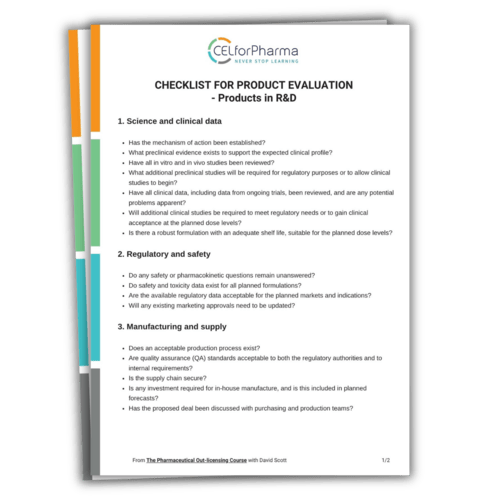
Want to take these tips with you?
Download the full guide below 👇
The full checklist: evaluating an R&D product for out-licensing
1. Science and clinical data
- Has the mechanism of action been established?
- What preclinical evidence exists to support the expected clinical profile?
- Have all in vitro and in vivo studies been reviewed?
- What additional preclinical studies will be required for regulatory purposes or to allow clinical studies to begin?
- Have all clinical data, including data from ongoing trials, been reviewed, and are any potential problems apparent?
- Will additional clinical studies be required to meet regulatory needs or to gain clinical acceptance at the planned dose levels?
- Is there a robust formulation with an adequate shelf life, suitable for the planned dose levels?
2. Regulatory and safety
- Do any safety or pharmacokinetic questions remain unanswered?
- Do safety and toxicity data exist for all planned formulations?
- Are the available regulatory data acceptable for the planned markets and indications?
- Will any existing marketing approvals need to be updated?
3. Manufacturing and supply
- Does an acceptable production process exist?
- Are quality assurance (QA) standards acceptable to both the regulatory authorities and to internal requirements?
- Is the supply chain secure?
- Is any investment required for in-house manufacture, and is this included in planned forecasts?
- Has the proposed deal been discussed with purchasing and production teams?
4. Legal and intellectual property
- Are any patents valid, and when do they expire in all required markets?
- Is there any risk of patent disputes with third parties?
- Are any trademarks registered and free from dispute in the required markets?
- Are the trademarks linguistically acceptable in those markets?
- Are there any outstanding insurance claims, and have the company's insurers reviewed and cleared the product?
- What are other licensees doing, and is there a requirement or an option to exchange data with them?
5. Commercial and market
- Does the approved or expected data sheet profile and the proposed indications support the anticipated competitive position?
- Is the expected or actual price and reimbursement level secure in the target markets?
- Are changes expected, for example due to patent expiry of competing products?
- Is the licensor planning to introduce any new or upgraded competing products?
- Is any market research available to support evaluation of the product's potential?
- Is the planned market share achievable, and are pricing expectations realistic given the market dynamics?
- Are generic competitors, for this product or for major competing products, expected, and could they reduce volume forecasts or prices?
- Who are the target clinician groups, in terms of both key opinion leaders and potential prescribers?
- How will this product fit into existing visit profiles, and what additional resources may be needed to engage new clinician groups?
- Will the expected margin support the planned promotional investment?
- What will be the impact on the existing business and product mix?
- Is seasonality a relevant factor?
Why this checklist matters
When a potential licensee evaluates your product, they will ask all of these questions and more. If you cannot answer them clearly and confidently, it signals risk. Gaps in preclinical data, unresolved safety questions, uncertain reimbursement, or weak intellectual property protection can stop a deal before it begins.
Preparing your answers in advance allows you to:
- Present your product with clarity and credibility
- Anticipate and address concerns proactively
- Strengthen your negotiating position
- Accelerate the due diligence process
Download the checklist & take this insight with you:
Continue your learning from David
If you’d like to learn more from David, CELforPharma also offers a 1-day, hands-on course where you'll:
- Understand the overall out-licensing process and key decision points
- Learn how companies decide which type of deal to pursue
- Get introduced to valuation concepts using the rNPV model
- Gain clarity on common legal agreements and term sheet elements
- Understand how to prepare for partner identification and engagement
The Pharmaceutical Out-licensing Course
With David Scott

Don’t miss the latest insights from our expert faculty
Subscribe to our newsletter to:
- Stay on top of the latest expert insights
- Receive invitations to upcoming educational webinars
- Get updates on our courses and training programmes