By Dr Stefan Walzer, MArS Market Access & Pricing Strategy GmbH, trainer of the CELforPharma Healthcare Payer Negotiations Course
Almost all preparation for a payer negotiation goes into the substance. The dossier. The budget impact model. The comparator argument. The price and the fallback price.
Very little goes into the question that often decides how the meeting ends: who is sitting on the other side, and how do they negotiate?
Across European market access negotiations, three behavioural patterns come back again and again. They are not personality types, and they are not a judgement about the individual. They are negotiating styles, usually shaped by the institutional position the person holds. Recognising which one you are facing, ideally in the first fifteen minutes, changes what you should do next.
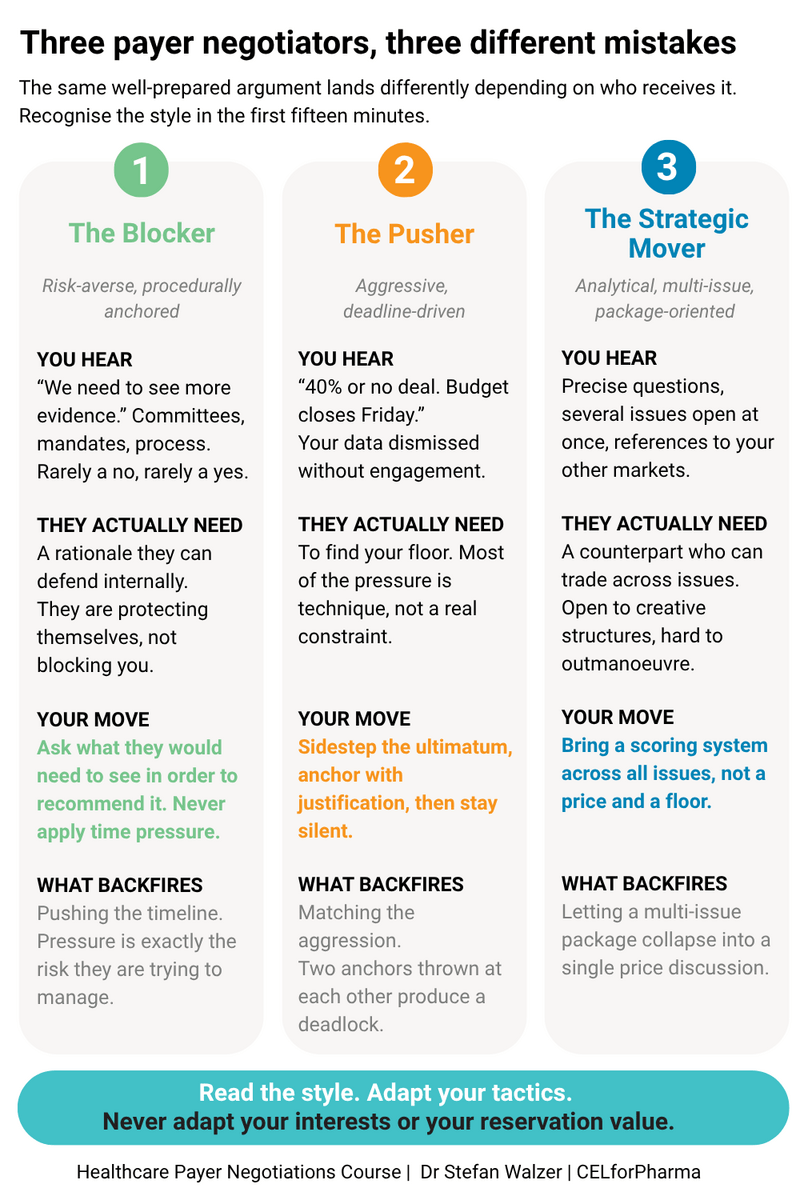
The three payer negotiating styles at a glance
1. The Blocker
What you see. Repeated requests for additional evidence. References to guidelines, committees, and mandate constraints. Non-committal answers, with everything deferred to process. Silence after you put a proposal on the table, and that silence is not consent. They are waiting, not agreeing. Points you thought were settled reopened at the next meeting.
What is actually happening. The Blocker is rarely obstructing you personally. They are protecting themselves. They cannot defend a yes internally without a documented rationale, so the safest available answer is “not yet”.
What works. Reduce their personal decision risk. Ask the question that gives them a route forward: “What would you need to see to be able to recommend this?” Give them structured evidence they can present internally without rewriting it. Name their constraint out loud: “I understand your HTA mandate requires...” Offer stepwise commitments, such as a pilot, an interim listing, or a conditional approval with a defined review point.
What backfires. Time pressure. A deadline pushed onto a Blocker deepens the resistance, because it increases exactly the risk they are trying to manage.
2. The Pusher
What you see. An extreme opening anchor, delivered with confidence. Artificial deadlines. Ultimatums and take-it-or-leave-it language. Your data dismissed without engagement. New demands added halfway through the session.
What is actually happening. The Pusher is testing where your floor is. Most of the pressure is technique, not a real constraint. The deadline they name is usually not a real deadline.
What works. Do not push back directly. Step around it. Ignore the threat instead of answering it, and look behind the position: “I hear budget pressure. What is your actual target impact?” Set your own anchor early, with full justification, rather than reacting to theirs. Label every concession you make, so that it is understood as a deliberate move and not as a sign that you are starting to slip. And after an ultimatum, pause. The party who speaks first after a proposal is usually the one who concedes first.
What backfires. Matching the aggression. Two anchors thrown at each other produce a deadlock, and you pay for it in the next negotiation with the same people.
3. The Strategic Mover
What you see. Precise, probing questions. Several issues negotiated at once, with a refusal to close any single one. Package offers and conditional concessions. References to your other products, your other markets, and competitor deals. Visible preparation, with their own models on the table.
What is actually happening. This is the most capable negotiator of the three, and also the most productive one to meet. They think in packages and precedents, and they are open to creative structures, as long as you can match them.
What works. Match the analytical rigour. Arrive with a scoring system across all negotiable issues, not just a price and a floor. Be transparent about your priority order, though never about your reservation value. Make package offers: “If you move on X, we can move on Y and Z.” Look for differences in priority, because that is where the trades are. They may value outcome certainty far more than you do, while you value speed to listing. Contingency contracts and outcome-based structures work particularly well here.
What backfires. Single-issue negotiation. If you reduce a multi-issue package to a price discussion, you hand the advantage to the person who prepared the package.
The rule that applies to all three
Read the style. Adapt your tactics. Never adapt your interests or your reservation value.
Most of the damage happens when tactics and interests get confused. Adapting means changing how you build and present your case. It does not mean moving your floor because the other side was loud, or slowing your own timeline because they were procedural. A concession that is made in response to behaviour rather than to a reciprocal move is not a strategy. It is a habit that appears under pressure.
And expect the style to change. The same person can open as a Strategic Mover, turn into a Pusher when the committee deadline gets close, and end as a Blocker once the decision has to be written down. So the diagnostic question is not asked once at the start. It is asked continuously:
What does this behaviour tell me about the constraint they are under?
The answer is almost always available. It is also almost always actionable.
Continue your learning from Stefan
If you’d like to learn more from Stefan, CELforPharma also offers a 1-day, hands-on course where you'll learn how to:
- Recognise and apply core negotiation principles and styles
- Develop and apply a structured negotiation strategy
- Tailor your negotiation approach to healthcare payer dynamics
- Challenge common payer myths and negotiation biases
- Practise and refine your payer negotiation skills through real-world cases
The Healthcare Payer Negotiations Course
With Dr Stefan Walzer

Don’t miss the latest insights from our expert faculty
Subscribe to our newsletter to:
- Stay on top of the latest expert insights
- Receive invitations to upcoming educational webinars
- Get updates on our courses and training programmes