By Dr Nick Proctor and Megan O'Brien, expert trainers of the Understanding Pharma Market Access & Payers in Europe course.
There are five functional categories of payers in pharma: national payers, regional payers, local payers, clinicians and KOLs, and patients. Each holds a different position in the access decision, works with a different level of evidence, and responds to different drivers. Understanding which category you are dealing with should determine the evidence you bring and how you engage.
Many pharmaceutical companies still see payers as a barrier rather than as customers. A simple shift in mindset, and a better understanding of who the payer actually is, makes a significant difference.
It is true that payers often seek to limit the use of medicines or to pay less for them. But their motivations differ. The key to managing market access across Europe is to master the system in each major market: to understand the relative importance of the different payer types, and the differences in their decision-making criteria.
There are many ways of categorising payers. One of the most useful is functional.
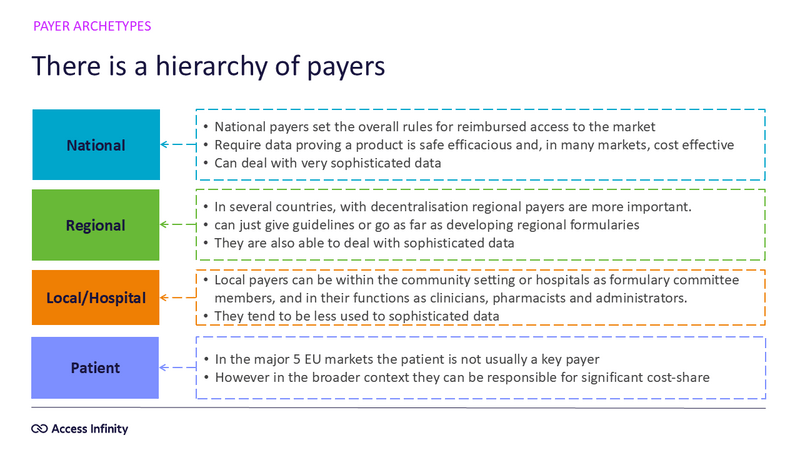
National payers
National payers set the overall rules for reimbursed access to a market. They require data proving a product is safe, efficacious and, in many markets, cost effective. They handle very sophisticated data and take a technical, scientific approach, so put greater emphasis on modelling population effects, because they want to understand how a new product will affect the system as a whole. They may also have political drivers.
Regional payers
Regional payers manage healthcare budgets within a region, and matter most in countries with decentralised health systems. They may issue treatment guidelines or go as far as developing regional formularies. They are able to handle sophisticated data and want to understand the impact on their region specifically. Although they hold no national responsibility, they can be highly influential. Politics and regional budget drive their decisions.
Local payers
Local payers sit within hospitals as formulary committee members, alongside their roles as clinicians, pharmacists and administrators. They tend to be less accustomed to sophisticated data and focus more narrowly on localised budget impact.
Clinicians and KOLs
Clinicians and KOLs influence decisions at national, regional and local level: as payers themselves, as members of consultative bodies, or as product and patient advocates. They are primarily interested in how a new product will affect their patients and their budget.
Patients
Patients push for specific treatments on the basis of performance, cost, or both, and their influence depends heavily on the market. Where patients make payments related to the cost of treatment they can be highly price sensitive. Where they make no payment, or a fixed payment independent of cost, they are far less so.
Same story, different message. Keep to the same general story across the different payers, but use tailored, relevant evidence to support it, reflecting the differing needs of whoever is making the decision.
Three ways to group payers:Nick Proctor and Megan O'Brien have put together a free slide snapshot on payer archetypes. It groups payers across Europe by health system structure, by their position in the health system, and by how they make pricing and reimbursement decisions, and shows which planning tasks each approach is useful for. → Slide Snapshot: Payer Archetypes in Europe |
Test yourself:5 single-choice questions on EU4+UK market access systems, payers and decision-making. → Test your knowledge of pharma market access & payers in Europe |
Frequently asked questions:
National payers, regional payers, local payers, clinicians and KOLs, and patients. Each holds a different position in the access decision and responds to different evidence.
National payers require data proving a product is safe, efficacious and, in many markets, cost effective. They handle sophisticated modelling, focus on system-wide impact, and may also have political drivers.
Yes. Clinicians and KOLs act as payers, as members of consultative bodies, and as influencers at national, regional and local level. They are primarily driven by the impact on their patients and their budget.
In the EU5 the patient is not usually a key payer. In markets and therapy areas where patients carry significant cost-share they become price sensitive, and can push for specific treatments.
Continue your learning from Nick and Megan
If you’d like to learn more from Nick and Megan, CELforPharma also offers a 1-day, hands-on course where you'll:
- Demystify market access concepts and payer decision-making
- Understand payer archetypes and how they differ across countries
- Gain clarity on evidence expectations and access pathways in major EU markets
- Learn how to embed market access into a cross-functional strategic process
Understanding Pharma Market Access & Payers in Europe
With Dr Nick Proctor & Megan O'Brien


Don’t miss the latest insights from our expert faculty
Subscribe to our newsletter to:
- Stay on top of the latest expert insights
- Receive invitations to upcoming educational webinars
- Get updates on our courses and training programmes