Discount or rebate.
Co-payment or co-insurance.
Margin or mark-up.
These pairs get used as though they mean the same thing, in meetings where the difference decides what a patient pays and what the company earns.
In the opening module of their 2-day Pharma Pricing Course, Gary Johnson and Sam Johnson put these terms in front of participants and ask what each one means. This glossary is that list: 29 terms, each with a precise definition.
The confusion comes in pairs
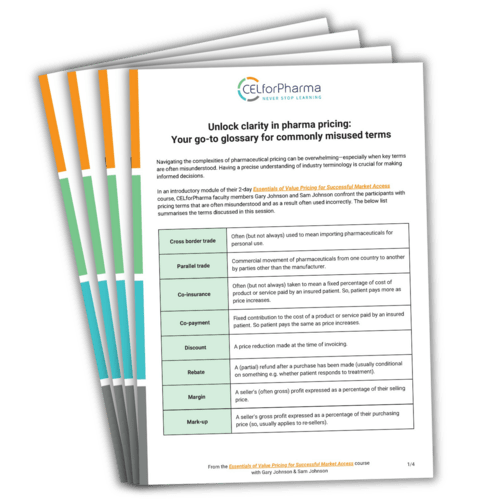
Most of the glossary is built around terms that sound interchangeable and are not. Here are four of the pairs, with the definitions as they appear in the download.
| Term | Definition |
|---|---|
| Co-payment | Fixed contribution to the cost of a product or service paid by an insured patient. So patient pays the same as price increases. |
| Co-insurance | Often (but not always) taken to mean a fixed percentage of cost of product or service paid by an insured patient. So, patient pays more as price increases. |
| Discount | A price reduction made at the time of invoicing. |
| Rebate | A (partial) refund after a purchase has been made, usually conditional on something, for example whether the patient responds to treatment. |
| Margin | A seller's, often gross, profit expressed as a percentage of their selling price. |
| Mark-up | A seller's gross profit expressed as a percentage of their purchasing price, so it usually applies to re-sellers. |
| Price elasticity | The percentage change in volume caused by a 1% increase in price. This is a mathematically precise term. |
| Price sensitivity | The importance customers place on price, an imprecise term. |
The glossary pairs off seven more: cross border and parallel trade, flat and uniform pricing, international and national reference pricing, price and value, price taking and price making, formulary and negative list, demand side and supply side price controls.
"Price" is the least precise word on the list
The glossary reserves its longest warning for the most ordinary word in it. Price is what a customer pays, but there are different customers along the distribution chain, and prices can be quoted before or after discounts and rebates. So, there are many prices, and price always has to be defined precisely.
The same caution applies to the ex-factory price, the manufacturer's posted list price, which can be very different from the net price once discounts and rebates are taken off. The glossary notes that it gets used in pricing analysis because it is easy to see, while the net price is harder to assess, and answers that with a line worth borrowing: always better to be approximately correct than precisely wrong.
What is in the glossary
29 pricing terms, each with a precise definition, from the introductory module of The Pharma Pricing Course
The pairs that get confused most: discount and rebate, co-payment and co-insurance, margin and mark-up, price elasticity and price sensitivity, and seven more
The terms behind pricing systems: reference pricing, formularies and negative lists, demand side and supply side controls, tiered formularies
Download the glossary
Who wrote this glossary
Gary Johnson is Founder and Chairman of Inpharmation, a European consultancy that has worked on pricing or forecasting for roughly half of the new molecular entities launched in recent years. He is co-author of Value Pricing for Market Access and The AI Cube, and has been a CELforPharma faculty member since 2007.
Sam Johnson is Board Director and Head of R&D at Inpharmation, where he leads the development of its forecasting and pricing technology. He is co-author of the same two books, and joined the faculty in 2021.
They teach The Pharma Pricing Course together, and this glossary comes from the module they open it with.

Continue your learning from Gary and Sam
If you’d like to learn more from Gary and Sam, CELforPharma also offers a 2-day, hands-on course where you'll learn how to:
- Analyse payer types and global pricing & market access systems
- Recognise the role of health economics in pricing decisions, and its limits
- Use evidence-based frameworks and AI to analyse & predict payer behaviour
- Anticipate how international reference pricing affects your global strategy
The Pharma Pricing Course
With Gary Johnson & Sam Johnson


Don’t miss the latest insights from our expert faculty
Subscribe to our newsletter to:
- Stay on top of the latest expert insights
- Receive invitations to upcoming educational webinars
- Get updates on our courses and training programmes