The Advisory Board Meeting is one of the most commonly used tactics in the life of the Medical Science Liaison. This is no surprise: the impact of a well-executed Advisory Board can be very high on several levels: the advice and insights gained can be extremely valuable, mutual trust can be increased and projects can be set into motion.
That's why it's important you take the following 9,5 steps to make it impactful and of mutual benefit to both you and your experts. Because an Advisory Board Meeting can have a major impact if done for the right reasons and with the right execution...
Watch the 2-minute video by Maaike Addicks, MD, Medical Affairs expert and CELforPharma faculty member of the 1-day open enrolment course The Medical Plan and Tactical Implementation.
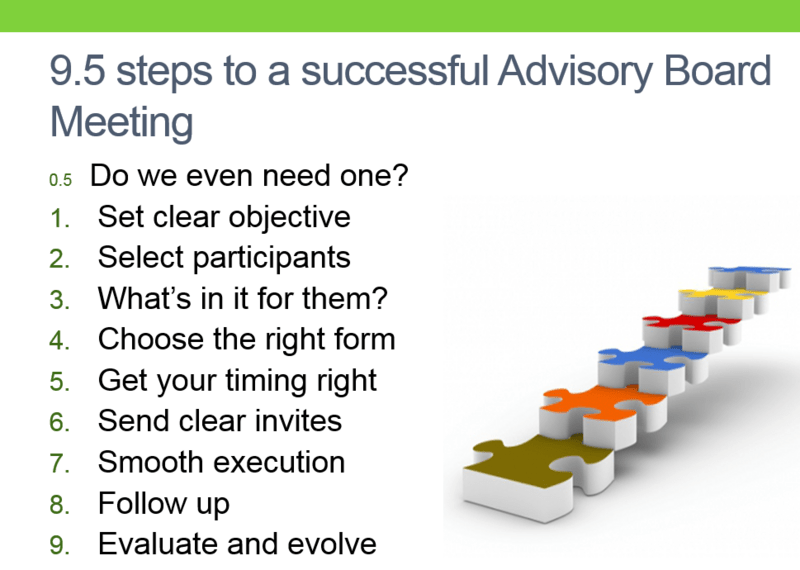
First of all, ask yourself: “Do we even need an Advisory Board Meeting?”
Because of this potential for high impact, it is likely you will find several Advisory Boards planned in the Medical Plan each year. In fact, it seems to have become a standard recurrent activity during the year, without anyone questioning the actual need and impact in the lifecycle of your specific product. Before you know it, you will be scrambling to think up subjects for the next upcoming Advisory Board Meeting.
The Meeting itself has become the goal instead of the mean. This is not effective, and most likely not compliant, either.
Whether it is an Advisory Board Meeting, a symposium or a Speaker Tour, tactics should only be used if you are certain they will have the right impact. Therefore, tactics should always originate from strategies, which in turn should be based on a thorough assessment of the current situation, using a SWOT, confrontation matrix or other analysis, and the resulting Critical Success Factors. If it turns out your Medical Affairs strategies would best be served with tactics other than an Advisory Board Meeting, please do not waste your and your experts' time doing one. Without a sense of direction, your meeting will have minimal impact and your experts will wonder why they were invited to participate at all. In addition, an Advisory Board Meeting without a justifiable purpose is likely to be non-compliant.
Some good reasons to hold an Advisory Board Meeting are:
Gaining advice from the experts on different topics, ranging from the place of a new product in the treatment landscape to how to deal with certain adverse events.
Gaining insights from the experts on daily clinical care or other subjects.
Under the right conditions, an Advisory Board can provide a springboard for cooperative projects.
By contrast, the following are some of the bad reasons to hold an Advisory Board Meeting:
Showing off-label or preregistration data unsolicited: depending on local rules and regulations, you are only allowed to share such data in very specific situations if there is a genuine need, i.e. if it is essential for the questions that need to be answered. Ensure all the proper documentation and approvals are in place before proceeding and only show the data necessary to gain the advice you seek.
To test the newest marketing messages: Market Research is much more appropriate and effective for that purpose, and your experts will appreciate the transparency of why they were invited to the activity.
Because according to your goals, you have to do three Advisory Board Meetings this year: if you feel a different tactic would be more suitable and impactful, talk to your manager. Your annual goals should not dictate your plans. In fact, it should be the other way around.
Now, if you have considered everything described above and you feel an Advisory Board would be the very best tactic, please ensure you take the other 9 steps to make it impactful and of mutual benefit to both you and your experts. Because an Advisory Board Meeting can have a major impact if done for the right reasons and with the right execution.
Continue your learning from Maaike
If you’d like to learn more from Maaike, CELforPharma also offers a 1-day, hands-on course where you'll learn how to:
- Understand the strategic importance of a Medical Plan and its core building blocks
- See how a strong Medical Plan enables successful engagement with internal and external stakeholders
- Select, plan, and execute Medical Affairs tactics that effectively implement the Medical Plan
- Assess the ROI of Medical Affairs tactics to ensure activities contribute real value
The Medical Plan and Tactical Implementation
With Maaike Addicks, MD

Don’t miss the latest insights from our expert faculty
Subscribe to our newsletter to:
- Stay on top of the latest expert insights
- Receive invitations to upcoming educational webinars
- Get updates on our courses and training programmes